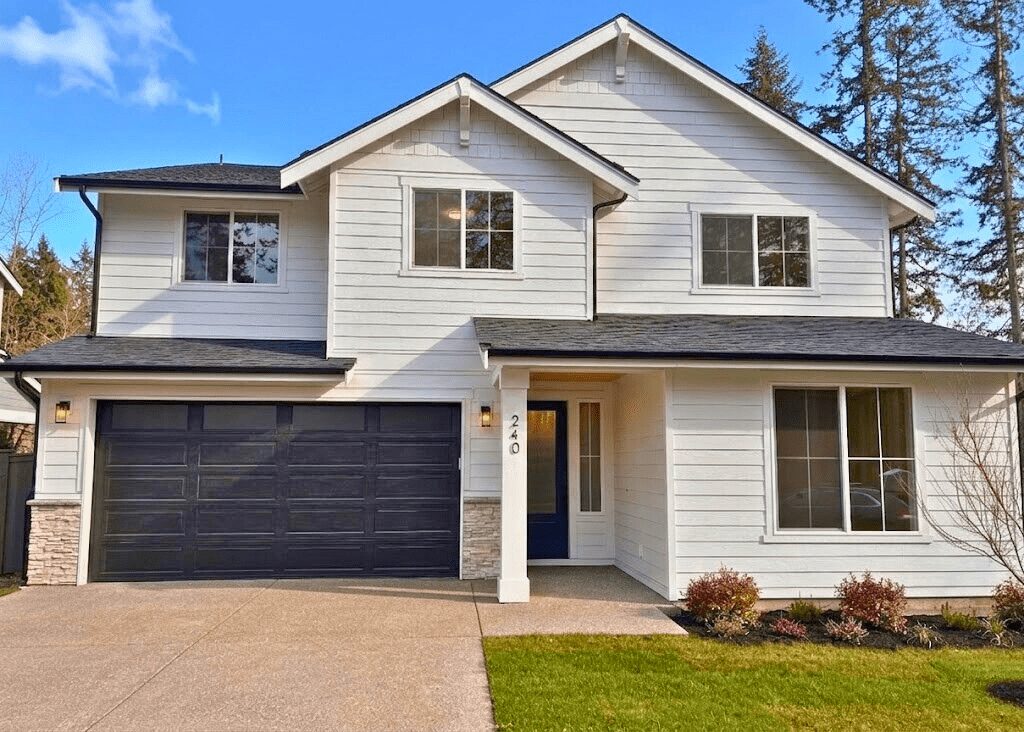
Cost of Building a Home in Gig Harbor, Washington? Pros and Cons and Potential Pitfalls.
Summary
- Building lets you customize the home to your lifestyle
- It is significantly more expensive than buying an existing home
- Time and complexity are major tradeoffs that everyone overlooks
- Regulations and site-specific challenges can become major pitfalls
- Too much customization can impact resale potential
Gig Harbor, Washington, has grown to become one of the most desirable communities in Washington State. And it’s no surprise when you consider the scenic waterfront, top-rated schools, and proximity to Tacoma, Seattle, and Seatac Airport.
However, with limited housing inventory, buyers relocating to the area often face a key decision: Should you buy a preexisting home or build from the ground up?
As Gig Harbor real estate experts, Dwell Home Team has seen just about every scenario. In fact, we have several clients currently building on land that we helped them purchase. Understanding the trade-offs between buying and building can help you make a smarter financial and lifestyle decision.
So let’s dive in!
Why People Love Building in Gig Harbor (Pros)
1. Custom Home Design: You Get What You Want
One of the biggest advantages of building a custom home is the ability to choose every detail, from the floor plan to materials, finishes, and colors. Instead of compromising with an existing home, you and your architect create something designed around your lifestyle.
And if you’re working with a great Gig Harbor builder (we are happy to share some names), they will also help you take full advantage of the lot to ensure you’re optimizing the views, driveway, backyard space, etc., which are key factors when you consider the resale value of the home.
2. Premium Quality & Craftsmanship
Custom homes typically offer higher construction quality than many speculative “spec” or what is also called “production” homes.
You choose the builder, subcontractors, and materials, which means you’re in greater control of the outcome rather than purchasing a home that might have been constructed using low-cost materials.
3. Better Long‑Term Value & Equity
While upfront costs are considerably higher (more on that below), custom homes generally hold their value well, especially when thoughtfully designed with energy efficiency, smart layout, and quality materials.
In markets like Gig Harbor, where housing supply and affordability are ongoing challenges, a custom home built on the right lot can be a solid long‑term investment.
4. Strong Local Builder Community
Gig Harbor is fortunate to have a handful of experienced, reputable builders who specialize in custom homes.
You’ll find that these builders have a deep understanding of local codes and environmental concerns, and are proficient at navigating shorelines, wetlands, and other highly regulated areas that can complicate the project.
If you want an introduction to the builders we keep on our short list, don’t hesitate to reach out.

Custom New Construction Home on Fox Island, sold in 2025 for $4.2M
The Real Costs: Expect More Than You Think (Cons)
1. Higher Construction Costs
Yes, roughly 30 years ago, it was cheaper, all things considered, to build a new home than to buy a preexisting one, but not anymore. Building is now a purely luxury activity, as building a custom home will cost 30-100% more per square foot than a preexisting structure. Why is this the case?
Very little, if any, land is for sale, vendors’ and material prices are through the roof, and permit and other regulatory fees have continued to increase.
Depending on the materials you select, we tell clients to plan on spending $400-$ 1,000 per square foot to build a custom home, and that is assuming you have already purchased the land.
This range can rise substantially if your property is difficult to access, has steep slopes, requires substantial site prep, or calls for specialty finishes.
This means a 3,000-square-foot home could easily approach or exceed $900,000 in construction costs alone, before land, design, permits, utilities, landscaping, or contingency costs are considered. Making the all-in cost of the home something in the $1,500,000 to $2,000,000 range.
2. Financing Complexities
Most buyers finance custom builds with construction loans, which differ from standard mortgages. These loans typically require a 20-25% down payment, additional documentation, and detailed project timelines and cost estimates.
Lenders also view construction loans as higher risk, which can lead to stricter approval criteria and often slightly higher interest rates than conventional financing.
As a result, securing financing may be more complicated and expensive than for the purchase of an existing home, especially if interest rates climb during construction.
In practice, we find that most clients purchase the land with cash and then secure a construction loan to develop the lot.
3. Time, You’ll Need A Lot of It
Are you prepared to wait two or three years, or even five years if you’re building on the waterfront? Sadly, this is not a joke.
The permitting and approval process is painfully slow, and the most sought-after builders may not be able to start your project for 2 to 3 years. This means it’s not uncommon for clients to be told it could be three to five years before they set foot in their new home.
4. You’ll Need to Make Hundreds of Decisions
While the opportunity to select every detail from tile to light fixtures, to windows, etc., may feel exciting, many clients find the sheer volume of choices can become overwhelming and stressful.
To streamline this process, many homeowners choose to partner with a professional designer. While this provides peace of mind and often ensures a showstopping look, just know the cost starts at $50,000 and can reach $200,000 for larger custom homes.
Local Challenges & Pitfalls to Watch For
1. Zoning and Land Use Constraints
Depending on where your homesite is located, you’ll be dealing with either the City of Gig Harbor or Unincorporated Pierce County zoning and land use, which can introduce some surprising limitations.
For example, many build sites have critical area designations, such as steep slopes, wetlands, and shorelines. These designations can require larger buffers around sensitive areas, additional geotechnical studies, or more expensive engineering solutions to gain building approval.
Understanding your constraints before purchasing land or locking in plans is crucial. Engaging early with zoning professionals and civil engineers can save time and expense later.
2. Permitting: Red Tape and Delays
Building in Gig Harbor requires navigating both planning and building permits, each with its own rules and timelines. Planning permits address land‑use compliance and site work (e.g., driveways, lot modifications), while building permits focus on structural, fire-safety, and mechanical standards.
For projects near shorelines or wetlands, additional permits and studies will be required, adding more complexity and time.
3. Environmental & Climate Considerations
Gig Harbor’s lush, at times rainy environment presents maintenance considerations. Frequent precipitation and proximity to saltwater require careful design choices for roofing, siding, foundations, windows, and drainage management.
Without proper planning, water infiltration could damage your newly built asset or dramatically impact its resale potential.

Tips to Minimize Risks
Here are strategies to successfully navigate the custom build process in Gig Harbor:
Start with a Feasibility Study: Engage your builder, architect, and civil engineer early, ideally when you have the property under contract with a feasibility contingency in place.
A proper study will tell you if the site can be built on, the location of the home, and give you a sense for the cost involved in getting the land prepped for construction.
Choose Local Professionals: Builder and subcontractor experience in Gig Harbor and Pierce County pays dividends, especially when it comes to local inspection expectations and material availability.
Understand permitting early: Discuss permitting timelines and requirements with the city planning and building departments. Permits often take longer than expected and represent a major gating factor.
Plan for Cost Overruns: Add 20% to your budget to account for unforeseen issues.
Conclusion
Building a custom home in Gig Harbor can be deeply rewarding as it offers the chance to create a truly one-of-a-kind home that fits your exact lifestyle.
The higher costs, regulatory complexity, and timing challenges are real considerations. If you value control over the design, quality of craftsmanship, and have the financial flexibility to navigate budget and schedule uncertainties, building a custom home here might be an excellent choice.
However, if your priorities lean toward affordability, predictability, or minimal involvement in construction decisions, purchasing an existing home or renovating might be a more pragmatic path.
Whatever your path, investing time in researching and talking with local builders and real estate experts will make the journey smoother and more successful.

Leave A Comment